
Solar Yantra (Surya Yantra): Sacred Geometry of Divine Light

Friends, today I want to tell you about the Surya Yantra — a sacred geometric diagram that helps you connect with the energy of Surya, the Sun God and the source of all life in the Universe. In the Hindu and tantric traditions, this yantra has long been considered one of the most powerful tools for working with solar energy.

Sacred Meaning and Symbolism

A yantra is a mystical diagram. It serves as a tool for meditation and worship, and it also embodies the divine essence of a specific deity. The Surya Yantra was created specifically to convey the cosmic energy and qualities of Lord Surya — the one revered since ancient times as the primal source of light, life, and energy.

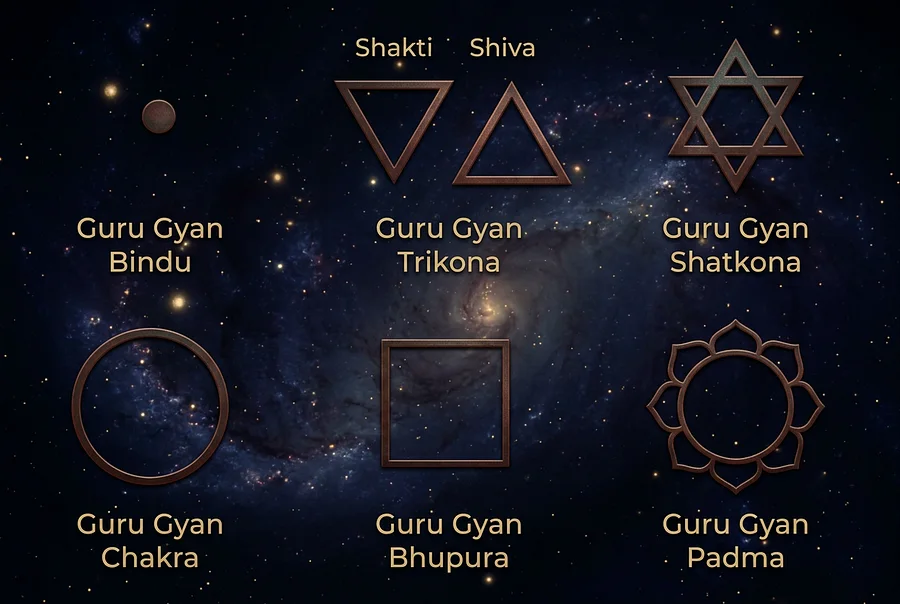
The yantra’s design consists of intricate geometric patterns with a central point — the bindu. It symbolizes the deity itself. Various shapes emerge from the bindu: triangles, circles, lotus symbols. The outer square symbolizes the four cardinal directions and creates a sacred space for concentrating divine energies.

For me, this isn’t just a symbol — it’s a living channel for transcendent power. The yantra embodies divine radiance and becomes a focal point for the Sun’s life-giving energy. Its geometric patterns reflect cosmic order and the harmonious structure of the Universe. When you work with the Surya Yantra, it helps you go through a spiritual transformation and protects you from negative influences. It’s activated through your devotion and correct practice.

The Geometric Structure of the Surya Yantra

surya yantra meaning_optimized

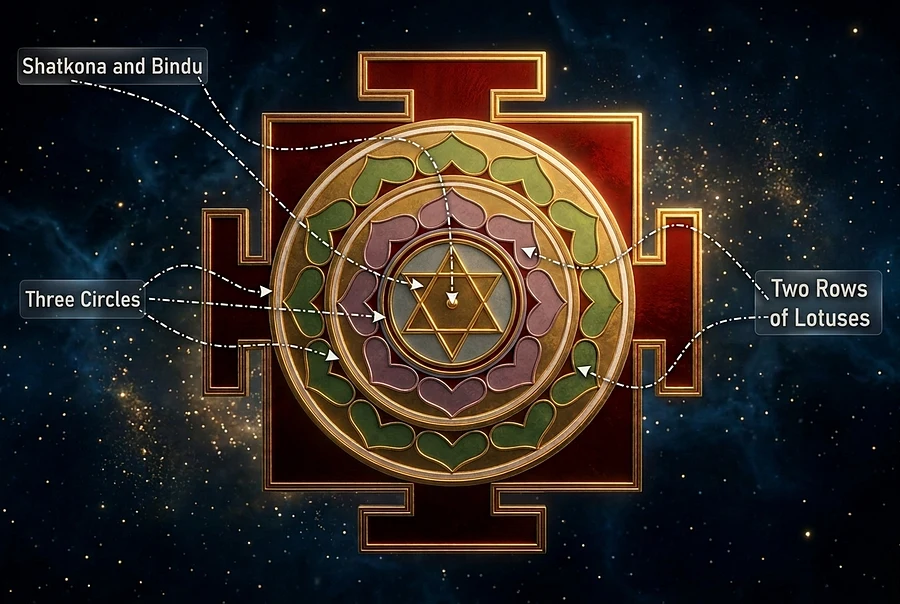
The Surya Yantra has a complex, multi-layered structure. Every element of it carries deep symbolic meaning.

The yantra begins with a single-tiered sacred enclosure — the bhupura. It creates a protected space for concentrating divine energies.

Inside the bhupura is an eight-petaled sacred lotus — the ashta-dala padma. Its petals are oriented toward the cardinal and intermediate directions. This lotus symbolizes the unfolding of consciousness and spiritual awakening under the influence of solar energy.

At the center of the lotus are two concentric circles, one inside the other. The inner circle encloses a square, and the square encloses a third circle. This circle surrounds a triangle — a trikona, pointing upward. The trikona symbolizes the masculine principle and the lingam — the Sun’s creative power. At the very center of the trikona is a fourth, inner circle, and at the center of the entire composition sits the bindu — the primal point of creation.

The Numerological Symbolism of the Sacred Numbers

The structure of the Surya Yantra is based on five key numbers — one, two, three, four, and eight. Each one carries a specific esoteric meaning.

One belongs to the bhupura. It symbolizes the source, the monad, the first principle, and the Absolute One. This number represents spiritual equilibrium and the divine sign of universal life. One is an odd number; it represents the masculine principle and includes qualities such as day, light, and the first of the five elements — ether (akasha). Astrologically, one is connected to the Sun — Surya.

Two is represented by the two outer circles. It embodies duality, polarity, and the diversity of the manifest world. Two is an even number; it symbolizes the feminine principle, the power of Shakti, night, darkness, and the Moon. Two represents complementary opposites: day and night, right and left. It corresponds to the second element — air (vayu), is astronomically linked to the Moon (Chandra), and represents the Ajna chakra.

Three is embodied in the trikona. It symbolizes perfection, the trinity, and the divine family — unity plus diversity, which equals perfection. Three shows up in the trinity of Brahma-Vishnu-Shiva, in the three gunas (sattva, rajas, tamas), in the three worlds (triloka), and in the three times. It corresponds to the third element — fire (agni), and astrologically it’s connected to Jupiter (Brihaspati).

Four is reflected in the square and the four full circles. It denotes completeness, the practical element, and worldly balance. It’s a perfect number on the higher plane: the four Vedas, the four cardinal directions, the four phases of the Moon, and the fourth element — water (ap). Astrologically, four is connected to Rahu and symbolizes the Muladhara chakra.

Eight is embodied in the ashta-dala padma. It signifies perfection, fortune, and divine justice. Eight is an even number, a symbol of motherhood, and the first cubic number (2³). It’s represented in the eight forms of Shiva, the eight treasures of Kubera, the eight mothers (ashta-matrikas), and the octave of prakriti. Astrologically, eight is connected to Saturn (Shani).

Surya Yantra: An Esoteric Analysis

The Yantra's Architecture in Detail

Let’s go through the architecture of the Surya Yantra once more — this time in more detail. The yantra consists of a single-tiered sacred enclosure — the bhupura. Inside it is an eight-petaled sacred lotus — the ashta-dala padma, whose petals are strictly oriented toward the cardinal directions. Inside the padma are two concentric circles. The inner circle encloses a square, and the square is surrounded by a third circle. This circle includes a triangle — a trikona pointing upward — a symbol of the masculine principle and the lingam. The innermost, fourth circle contains the bindu — the central sacred point.

Expanded Esoteric Symbolism

The number four doesn’t only appear in the square. It also shows up in the four psychic powers: chit-shakti — the power of consciousness, jnana-shakti — the power of knowledge, kriya-shakti — the power of action, and iccha-shakti — the power of will. These four powers form the foundation of spiritual practice.

The threefold structures include three categories of time: bhuta-kala (the past), vartamana-kala (the present), and bhavisha-kala (the future). Also part of this is the divine triad of goddesses — Saraswati, Lakshmi, and Parvati — which complements the masculine trinity.

The Pancha Tattva and Cosmic Correspondences

The yantra integrates the five fundamental elements — the pancha tattva: akasha (ether), vayu (air), agni (fire), apah (water), and prithvi (earth). Each element resonates with a specific part of the structure and creates an energetic matrix for your meditation practice.

The astronomical symbolism highlights the duality of the Sun (Ravi/Surya) and the Moon (Soma/Chandra). This duality is reflected in the geometry of the circles and their positioning relative to each other.

Every element of the Surya Yantra resonates with specific cosmic forces and astrological influences. The central bindu is tuned to solar energy, and the elements surrounding it create a harmonious system of planetary correspondences.

The eight-petaled lotus activates a connection to the eight directions of space and their corresponding planetary guardians — the lokapalas. The concentric circles symbolize orbital cycles and cosmic rhythms, while the triangle represents ascending energy, moving from the earthly plane toward the divine.

This intricate geometric system creates a powerful resonator. It’s capable of synchronizing your consciousness with cosmic cycles and planetary influences — especially with the Sun’s beneficial energy.

The Numerical Component: The Magic Square of the Sun

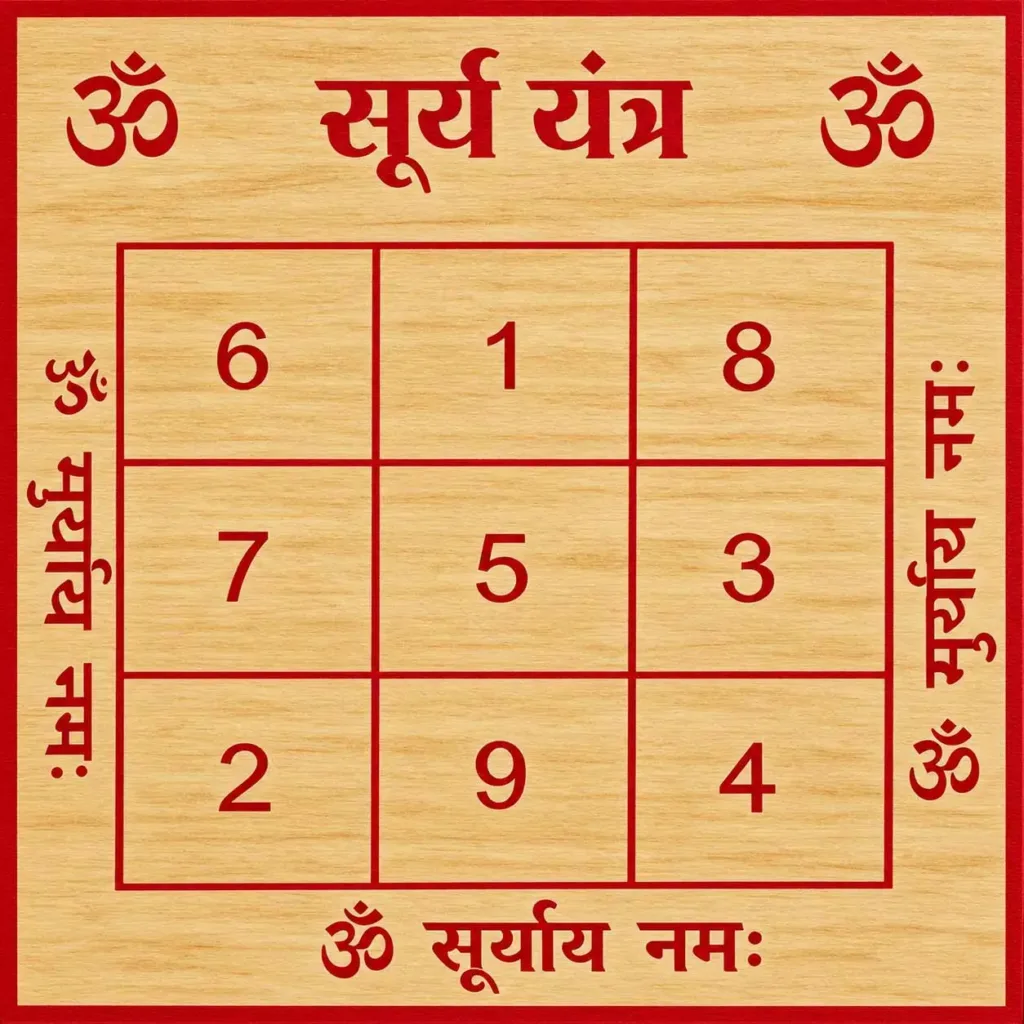
Beyond its geometric structure, the traditional Surya Yantra also includes a numerical yantra — a 3×3 magic square. The numbers in it are arranged so that their sum in any direction — horizontal, vertical, or diagonal — equals 15.

This magic square carries special symbolic significance. The number 1 symbolizes new beginnings and fresh opportunities. The number 5 is associated with change and creative potential. And the number 15 — the resulting sum — embodies unwavering focus and the Sun’s charismatic energy.

According to ancient texts, every number in the square resonates with specific cosmic vibrations and creates a harmonious energy field. While meditating on the numerical yantra, move your gaze left to right across the top row, then right to left across the middle row, and left to right again across the bottom row. This is what gives rise to a distinct rhythm of concentration.

Meditation Techniques for Working with the Surya Yantra

A deep meditation practice with the Surya Yantra is based on a system of seven layers — avarana. They represent different levels of consciousness and cosmic energy. In practice, you gradually move from the outer layers to the central point, and back again.

The Seven Avaranas of the Surya Yantra:

1. The outer squares (bhupura) — the protective enclosure
2. The outer circle with 12 lotus petals — cosmic cycles
3. The intermediate circle — the flow of energy
4. The inner circle with 8 lotus petals — the eight directions
5. The inner circle — concentration of power
6. The shatkona (two intersecting triangles) — the union of opposites
7. The bindu (central point) — the source of all existence

How it’s done. Start the meditation by fixing your gaze on the central point — the bindu. Then slowly expand your attention outward, moving through each layer to the outer enclosure, and then reverse the movement back toward the center. Try not to blink, and maintain unbroken concentration for 30 minutes.

Once you’ve mastered the technique with your eyes open, move on to visualizing it with your eyes closed — try to recreate the yantra’s exact image in your mind. This advanced practice can take many years of regular effort, but it leads to significant spiritual insights and material achievements.

Timeframe. Once you install the yantra, it will need 10-15 days to adapt to the energy field of the room. Fully mastering the meditation technique, meanwhile, can take several years of consistent practice.

Vedic Roots and Traditions

Сурья бог Солнца на семи лошадях_optimized

The ancient Vedas don’t contain direct mentions of worshipping the Sun in the form of a yantra. But they lay a powerful foundation for venerating Surya. The Rigveda — one of the oldest Vedic texts — is full of hymns dedicated to the Sun as the dispeller of darkness and ignorance.

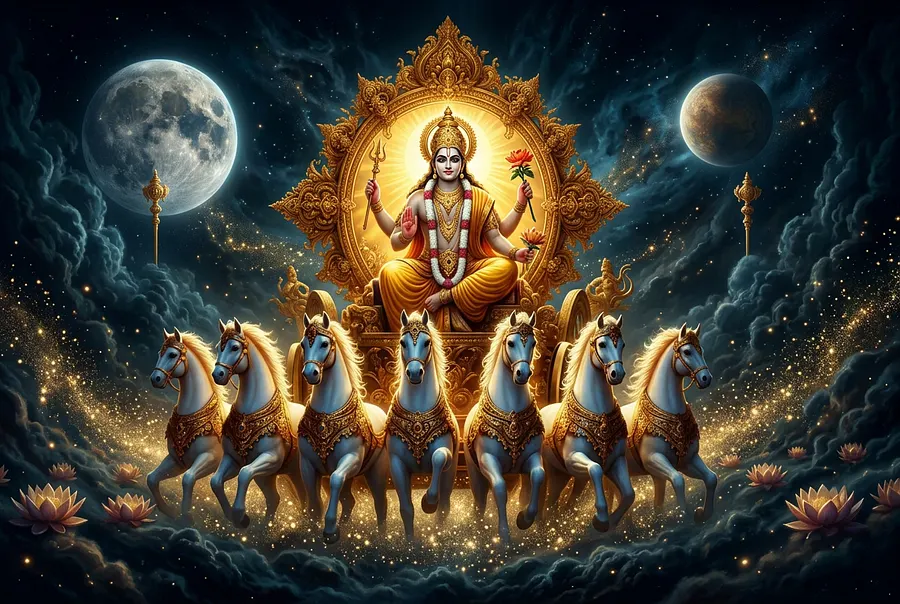
In later Vedic and Puranic literature, the concept of using special geometric diagrams for worship developed extensively. The Puranas tell of kings and sages who worshipped Surya for health, prosperity, and divine knowledge. The Sun is described as a supreme deity, seated on a chariot drawn by seven horses. These seven horses symbolize the seven chakras and the seven colors of the spectrum. The practice of using yantras is deeply rooted in exactly these traditions — they sought to create a tangible representation of divine energy for focused worship.

Practical Use and Rituals

Place the yantra in a clean, sacred spot — a meditation room or a home altar. The ideal placement is on the eastern side of the house, facing west, so the yantra charges with the energy of the rising sun. Before using it, cleanse the yantra and the surrounding space: wash it with holy water or raw milk, and light incense or an oil lamp.

Modern Forms of Use

Besides the traditional metal plates, the Surya Yantra is also engraved onto jewelry — rings, pendants, bracelets, and necklaces. Personal yantras like these give you constant contact with solar energy, and you can wear them as protective amulets. Yantras engraved on gold or copper are especially effective — metals traditionally associated with the Sun.

Materials Used:

Gold — the Sun’s most auspicious metal
Copper — an accessible alternative with good conductive properties
Brass — a popular choice for stationary yantras
Silver — for strengthening the lunar-solar balance

Include an offering of fresh flowers, incense, and fruit in your daily practice. Repeating the Surya mantra “Om Hram Hrim Hraum Sah Suryaya Namah” is especially important — it activates the yantra. Repeat the mantra 108 times, using a mala. Other powerful mantras include the Gayatri Mantra and the Aditya Hridayam Stotram.

In your meditation practice, contemplate the yantra daily, focusing on the central point, and gradually widen your attention to take in the entire geometry. While meditating, focus on your intentions — building confidence, improving your health, achieving spiritual goals.

шри янтра золото_3

Beneficial Effects

The Solar Yantra has a multi-faceted effect on your life. On the health side, it boosts physical and mental energy, improves eyesight, and strengthens the immune system. I especially recommend it for people with a weakened or afflicted Sun in their astrological birth chart.

Main Areas of Effect:

  • Leadership and success: strengthens leadership qualities and willpower, draws in fame and recognition
  • Spiritual development: promotes the growth of consciousness, activates the Manipura chakra, deepens meditative states
  • Protection and purification: dispels negative energies, protects against harmful influences
  • Vitality: increases overall energy levels, improves health and immunity

How It Works

The yantra works as a channel for Surya’s cosmic vibrations and tunes you into divine frequencies. It has an especially strong effect on the Manipura chakra — the energy center of power and confidence, located in the area of the solar plexus.

Contemplating the geometric forms creates a distinct state of consciousness that supports spiritual transformation. The meditative process activates the body’s inner mechanisms of self-healing and harmonizes your energy system. Combining the visual symbol with the sound vibrations of mantras multiplies the effect of the practice many times over and creates a powerful resonance between your inner energies and cosmic forces. Study the traditional Sun mantras for the best results.

For me, the Solar Yantra isn’t just a religious symbol — it’s a powerful tool for harmonizing your inner energies and reaching spiritual excellence. If you use it regularly, with devotion and proper understanding, it will become a source of light, strength, and wisdom for you in everyday life.

Наши статьи